
Baile: Edison and España


This summer, FIFA World Cup fever spread like wildfire throughout the world. Soccer hosted its most heralded tournament here in North America, and it’s safe to say that it did not disappoint. The form on the pitch was some of the greatest seen at any World Cup, but the most beautiful part was watching how the host countries of Canada, Mexico, and the United States embraced our friends from all across the globe and seeing, in turn, how our friends from across the world embraced the host nations. To see Lawrence, Kansas, wrap its arms around Algeria, to see Mexican fans pack the Estadio Azteca to the gills every single night, and to see Scottish fans literally drink Boston dry and put traffic cones on monuments are all signs that, despite our often superficial differences, we as humans are all connected. It’s funny how a little ball can bring people together.

If you have been away from the world of that little ball or have never dipped your toes into it, here’s something elementary that you need to know: Spain is golden. Not only did Spain’s men’s team just claim the 2026 FIFA World Cup, but Spain’s women’s team claimed the 2023 FIFA World Cup, becoming the only country to win back-to-back men’s and women’s trophies. The homeland of my dear friend Sara Fernandez-Garcia has been dancing as a result of those two titles (and with the 2027 FIFA Women’s World Cup around the corner, the party might not be over anytime soon), but she and her fellow countrymen have so much to be proud of outside of just soccer. Spain has an extremely rich culture that, admittedly, deserves an article by an author far greater than I, but did you know that part of Spanish history and culture intersects with Thomas Edison?

The connection starts just north of the Spanish border in Paris, France, in 1889. The scene was the 1889 World’s Fair, and visitors would have seen quite a lot for the price of admission. In addition to seeing some of Edison’s inventions and even a glimpse of Edison himself, their eyes would have been fixed on the dazzling Carmen Dauset Moreno. “Carmencita” was born in 1868 in the town of Almería in the southeastern Andalusia region of Spain. Southern Spain has historically been home to people of many different backgrounds, and those diverse backgrounds helped give birth to one of Andalusia’s most exquisite art forms: flamenco dancing. Flamenco at its core is flashy, fierce, and flowing. It is not just a dance, and it is not just art. It is an expression of one’s soul, blending dance and music. If you have never watched a performance of flamenco, you ought to stop reading right now and search for it online. It was flamenco that Carmencita brought with her to the World’s Fair in 1889, and it was there that she caught the eye of a talent agent who brought her across the Atlantic Ocean to Broadway.
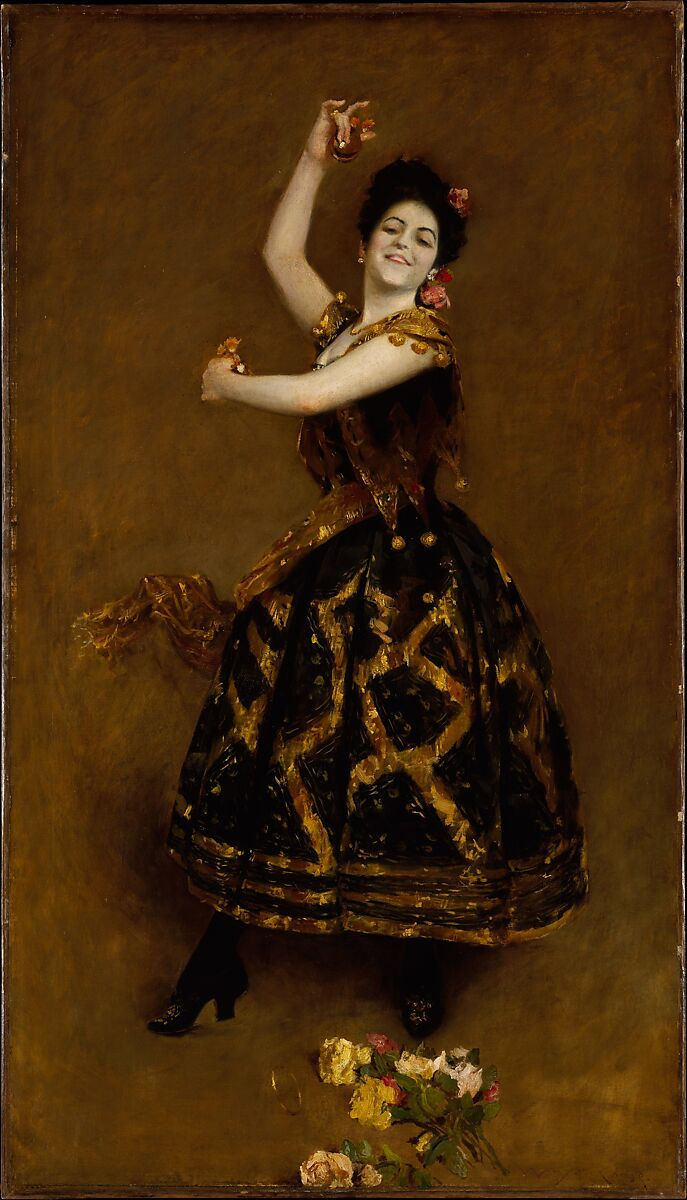
She came to New York City, where she in many ways served as the United States’ ambassador to flamenco. Carmencita quickly became a star for Koster and Bial at their eponymous music hall on Broadway, and she even performed an 81-week tour of the United States with few interruptions. Her popularity earned her portraits from noted artists John Singer Sargent and William Merritt Chase, and it was her popularity and familiarity that brought her to Edison’s Black Maria movie studio in 1894. Edison and his partner William Dickson wanted to push the limits of what movies could do, and who better to put the machine and the “illusion” of moving pictures to the test than their counterpart at the 1889 World’s Fair in Paris five years earlier, the beautiful Carmencita. If the beautiful intricacies of flamenco could be caught and brought to life on film, anything could.
Sure enough, Dickson and cameraman William Heise did just that. Although the film was only 21 seconds long, Dickson and Heise had preserved Carmencita and flamenco for future generations like you and me. The film features her twirling and dancing, and if you watch close enough, you can almost imagine the music she must have been dancing to. The Kinetoscope had brought Carmencita and flamenco to life. That feat alone would make the film groundbreaking, but Carmencita was also incredible because it marked the first time flamenco had been captured on film and, furthermore, the first time a woman was on film in the United States. Spain’s Carmencita became America’s first film actress.

Carmencita also became the first film to ever be censored. James A. Bradley, a New Jersey Senator and the creator of Asbury Park, New Jersey, was disgusted that Carmencita’s ankles were clearly showing. He told Edison that Carmencita would “shock the sensibilities of Asbury Parkites and deaden their sense of all that was modest and pure”. Bradley banned Carmencita from being shown in Asbury Park, along with banning other things that he believed would “ruin” the people of Asbury Park, including books, booze, hot dogs, women wearing bathing suits, and he even went so far as to ban African-Americans on his beach. Needless to say, Bradley’s opinion and decision to censor Carmencita had no major effect on the film, as scores more people were in love with it.

In fact, people today still love Carmencita. Thanks to the Library of Congress, you can watch Carmencita online at your leisure, and thanks to our lovely friends at Mechanical Flipbook in Ithaca, New York, you can watch Carmencita in the Don Gfell Education Center at the Thomas A. Edison Birthplace Museum! By simply cranking up the flipbook, you bring Carmencita back to life. Preserving people and moments for future generations is, after all, what Edison aimed to do with improving the motion pictures in the first place. Of the three Edison films available to watch in our mechanical flipbook, Carmencita gets the most “oohs” and “ahhs” from young and old alike. There are just some people who possess an indescribable level of talent that leaves you only capable of saying “ooh” and “ahh”, and Carmencita was one of them. The film was, and still is, golden. Spain’s recent success in soccer is golden. Spain is golden, flamenco is golden, and most importantly, Carmen Dauset Moreno was, and forever will be, golden.

Sources Used and Encouraged for Further Reading
Dickson, William K., dir. 1894. Carmencita. Featuring Carmen Dauset Moreno. West Orange, New Jersey: Edison Manufacturing Company. https://www.loc.gov/item/00694116/
Enforex. n.d. “Flamenco Dance.” Spanish Culture and Spanish Dance. Accessed July 19, 2026. https://www.enforex.com/culture/flamenco.html
Fox, Madeline. 2026. “Spain makes World Cup history: The first to win men's and women's trophies back-to-back.” NPR. https://www.npr.org/2026/07/17/g-s1-134232/spain-world-cup-history-women-men
Goldberg, David. 2006. “Greetings from Jim Crow, New Jersey: Contesting the Meaning and Abandonment of Reconstruction in the Public and Commercial Spaces of Asbury Park, 1880-1890.” Concept 30 (November). https://concept.journals.villanova.edu/index.php/concept/article/view/279/242
Insituto Cervantes. 2026. “Tribute to Carmencita Dauset Moreno.” Cultural Activities. https://cultura.cervantes.es/nuevayork/en-US/tribute-to-carmencita-dauset-moreno/187057
Martin, Ann, and Virginia M. Clark. 1985. “Research Guides: American Women: Resources from the Moving Image Collections: The Silent Era.” Library of Congress Research Guides. https://guides.loc.gov/american-women-moving-image/motion-pictures/silent-era
Orbach, Barak Y., and Allison S. Woolston. 2011. “Censoring Crimes.” Cardozo Arts & Entertainment Law Journal 29 (2): 251-278. https://larc.cardozo.yu.edu/cgi/viewcontent.cgi?article=1310&context=cardozoaelj
UNESCO. 2010. “Flamenco.” UNESCO Intangible Cultural Heritage. https://ich.unesco.org/en/RL/flamenco-00363
University of Alicante. 2010. “A researcher from the University of Alicante discovers that the Spanish Carmen Dauset Moreno was the first leading actress of sound films.” University News. https://web.archive.org/web/20210726042927/https://web.ua.es/en/actualidad-universitaria/2010/noviembre2010-8-14/a-researcher-from-the-university-of-alicante-discovers-that-the-spanish-carmen-dauset-moreno-was-the-first-leading-actress-of-sound-films.html
Have a question for Dillon? Reach out via email at dliskai@tomedison.org!


Loved reading about how Edison’s innovations intertwined with Spanish culture! It reminds me of the focus and quick reflexes I needed to master "run 3"—it's all about rhythm, just like Flamenco!
This is such a captivating read! I had never known about Carmencita and her huge role in early Edison‑era cinema. Connecting flamenco culture, World Cup excitement, and film history makes for such a unique narrative. Great work unearthing this wonderful cross‑cultural story. --wordcam
To react quickly at high speeds, shift your gaze toward the upper third of the screen (the horizon line). snowrider
What a fascinating look at how Edison's cultural ties with Spain appear through music games and customs! I especially loved your insights into flamenco's influence in sports, particularly during events such as the FIFA World Cup. It deepens our respect for culture and competition.
Although the objective is simple, every session in slope game tells a different story. One run may end almost immediately because of a careless mistake, while the next could become your longest attempt yet. That unpredictability keeps the game exciting without needing additional modes or objectives.